Every Row Was Correct. The Answer Was Still False.
I checked every row the assistant listed and each one was right. The sentence above them still told the user something untrue.
I checked every row the assistant gave me, and every row was right. The sentence above those rows was the part that was false.
The user had asked for a list of projects. The tool behind the assistant returned one page of a much larger set. The assistant wrote the reply as if that page were everything. Paraphrased, it went something like this:
List my projects.
Here are your projects: Project A, Project B, Project C, Project D, Project E.
There were many more than five behind that reply. Nothing in any single row gave it away. The false part was a claim that came from leaving something out.
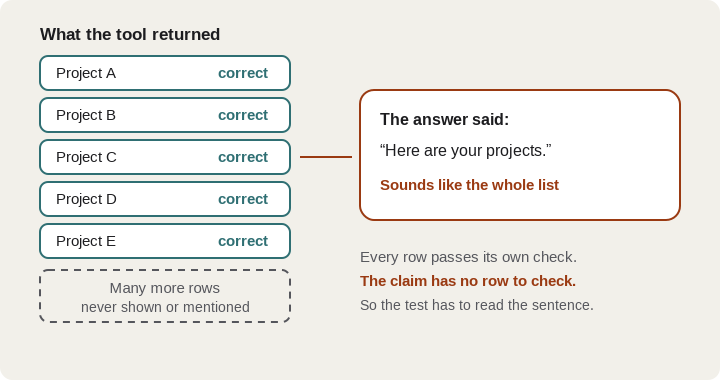
A row-by-row test misses this kind of failure. Check each name and value and everything passes. Check the answer the way a person would read it and the result flips. They asked for a list, got a partial list, and nobody told them more existed.
Pagination sounds like plumbing. It becomes product behavior the moment the assistant turns a page into a sentence. “These are the results” and “these are some of the results” are different claims, and the reply has to know which one it’s making.
The rows were right. The claim around them was not. So the story we wrote turned that distinction into behavior and into tests. The response gained the information it needed to know when the visible set was smaller than the available set, and the answer had to say so, beside the list, where a reader meets it. A caveat buried in a later paragraph still lets the first sentence make the stronger claim.
The rule is easy to state without any implementation detail: when more results exist, don’t present the current page as complete.
It also gave us a clean test with two sides. Hand the assistant a response in which the visible items are only a subset, and confirm that the answer says more exist. Then hand it a complete set and confirm that it doesn’t add a warning anyway. The second case matters as much as the first. Without it, the fix can decay into a permanent disclaimer, boilerplate that no longer responds to anything. With both cases, the sentence has to follow the state.
One more check guarded the future. A rule that fails if a new list-style tool forgets to carry the note meant the fix didn’t depend on someone remembering it.
Testing like this means following the user’s promise further than the implementation unit does. The list tool may have honored its page size. The screen may have rendered every row it was handed. Each part can pass its own check while the combined answer misleads, so I find it helps to read the answer with the implementation closed. What can a person infer from the words alone? Do they know the list is limited? Do they know another step could reveal more? If the caveat lives only in structured data, the user never gets it.
The rows were right. The claim around them was not.
Then I read the structured result and ask the reverse question. Which facts are sitting there that the sentence leaves out? A total larger than the visible set stops being background metadata the moment it changes whether “here are your projects” is true.
I’d seen this pattern before, on the mobile apps. A new time entry could be saved with a document attached, yet the attachment icon showed up only after a refresh. Stored data was right and the screen lagged. In another flow, an edited value looked saved until the user left and came back, and then the old value returned. The screen looked right and the stored data disagreed.
The partial list is the same problem in language. The interface sounds settled while the state underneath says something narrower. In all three cases the part under test was correct, and the claim the user received was not. That crossing point is where acceptance criteria need extra care. “Return a page” can be technically accurate and still not finish the user story. “Show the returned rows” can verify rendering and miss the false impression entirely. The criterion has to say what the answer must communicate when the result is partial.
It also shouldn’t overcorrect. The assistant doesn’t need to explain pagination mechanics in every reply. It needs to tell the user, in plain words, that this is a portion and more is available. The exact sentence can vary. The obligation can’t, and it should appear only when the structured result says the set is incomplete.
Scope mattered here too. The story didn’t try to rebuild every list source. It fixed the claim at the point where the product already had enough information to know the page was partial, so the focused change was to make the answer admit its limit. That kept the test stable even if the code underneath moved: supply a partial result with a larger set behind it and assert the user is told, supply a complete result and assert the answer doesn’t pretend otherwise.
It’s also why I don’t trust a check that only scans the final sentence for expected keywords. A reply can contain every right noun and still imply the wrong scope. The test has to read the claim, not just count the pieces.
A truthful reply also hands the user a next move. They can ask for more, narrow the request, change a filter, or accept what’s on screen. A falsely complete answer takes all of those options away by hiding the condition that makes them worth choosing.
After the change, the rows stayed exactly as they were. The sentence around them admitted there was more, and the person reading it could decide what to do next.
That left a quieter worry. Checks like these only help if they keep running while the product underneath keeps changing, and the first tests I wrote hadn’t survived that very well.