I Wrote a Test Checklist and Ended Up With a Feature Spec
One sentence with two filters has to survive five steps before it becomes an answer. Writing down where it can break turned out to be the spec.
Say a user types, “Show me my active projects on hourly contracts.” That’s eight words and two filters, and the assistant has to keep both alive all the way to the answer.
Between the sentence and the answer, those words get pulled apart, matched to real values, packed into a structured request, run, and described back in plain language. Any one of those steps can quietly lose a filter. The test story I wrote for this started as a plain checklist and walked the sentence through every step: one filter, two filters together, a field the product doesn’t support, a value that could mean two things, the result itself, and a check that nothing nearby had broken.
By the time it was done, it read less like a test plan and more like a description of what the feature was supposed to do.
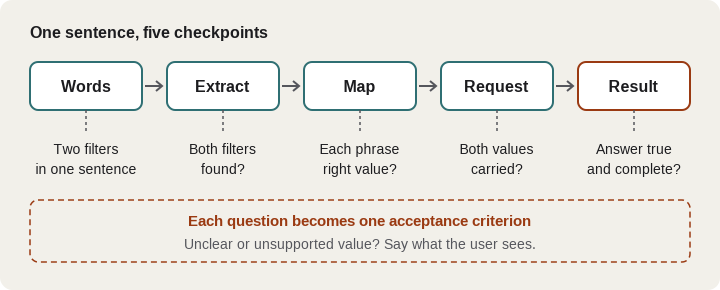
A weak checklist starts at the end: type a request, see whether results show up. A better one asks where meaning can get lost. Did the system pick up the right constraint? Did it map the value correctly? Did the request carry it? What happens when two constraints arrive together? What does the user see when one value is unclear, or isn’t supported at all?
Every one of those questions gives a developer a behavior to build and gives a tester a place to make it fail. It also stops one correct example from hiding a wrong rule in the middle.
On mobile, one of my early proposals asked for a new time-entry screen to preselect the signed-in user, the way another entry flow already did, while still letting people confirm or switch. I split it into the change being requested and a short list of numbered behaviors. It read nothing like a bug report. A bug report says what’s broken. This said what the person should experience instead.
A later mobile story went further. It separated what the user was trying to do from validation, feedback, error handling, and the existing behavior that had to stay put. That split made me ask questions I hadn’t been asking: who validates this, what does the user see when it fails, and what are we promising not to touch?
I wasn’t the only person writing stories, and I won’t pretend every behavior started with me. But proposals that began as QA findings became my habit: the auto-selected user, upcoming events on the home screen, filters that only apply when the user confirms. A finding gets a lot more useful once it’s a clear choice about how the product should behave. Demos and talking to users directly were part of the job too, and that’s where I’d hear a request in the user’s own words.
A request in ordinary language can be read several ways before it ever reaches software. “Support filters” leaves nearly everything undecided. Which words count as filters? Which values are valid? What happens when two are combined? What happens when a phrase sounds relevant but nothing supports it?
The filter checklist answered those as a path. It tested extraction and mapping separately, checked the request that carried the values, covered combinations, and treated ambiguity and unsupported input as behaviors to define instead of surprises to find.
A path like that is useful because failures land in different places. If extraction is wrong, the system never has the constraint. If mapping is wrong, a recognized phrase turns into the wrong value. If the request drops it, nothing downstream can recover it. If the results are right but the answer overstates them, the user ends up believing something false.
That’s where my tester and product hats overlap. The tester asks, “Where can this break?” The product question is, “What should happen there?” A useful criterion needs both. A case without a declared behavior can expose uncertainty, but it can’t confirm correctness.
A case without a declared behavior can expose uncertainty, but it can’t confirm correctness.
The filter rebuild became a story with edges. Typed inputs replaced a fuzzy chain of steps. The affected capabilities were listed, obsolete pieces were removed, and language behavior went into the acceptance checks so a wording change couldn’t undo the fix. Once the request had an explicit shape, it was far easier to say which inputs were supported and what ambiguity should do.
Later stories I wrote followed a steady pattern: context, scope, out-of-scope, functional requirements, acceptance criteria, and a QA plan. The subjects varied. Some were about typed inputs, some about complete answers, some about conversation state. Each one tied a claim a user could see to checks that the code had to keep passing.
Scope is what makes that structure work. A checklist can grow until it lists every concern anyone has ever had. A spec needs a line around the change. What behavior are we adding or repairing? Which neighboring paths have to stay as they are? Which related worry belongs in a different story?
The completeness story shows what a narrow criterion looks like. A list answer could contain correct rows while presenting one page of results as the whole set. The story put that into plain terms: when more results exist, the answer can’t imply the visible ones are everything. In chat, the target behavior looks like this.
List my open projects.
Here are the first ones. There are more that match, so I can narrow this down by client or status if you’d like.
That criterion can be implemented, and it can fail. Hand the response a subset with a larger total available, then check that the answer admits there’s more. If someone rewrites the implementation later, the user-facing promise is the same, so the test still has a reason to exist.
“Works correctly” can’t fail in a precise way. “Handles edge cases” doesn’t name an edge. “Supports filtering” doesn’t say whether ambiguity triggers a question, a default, an error, or an ignored phrase. Good criteria don’t have to expose internals. They say what information must survive, what the user must be told, and what neighboring behavior stays unchanged.
I read each criterion as a future failure message, too. If it breaks, will the sentence tell the next person which promise moved? If it won’t, it’s still too foggy.
Negative paths belong in the first draft, not as bonus cases bolted on after the happy path. Unsupported input, ambiguous values, and combinations are places where the product needs a declared response. Writing them early lets the developer choose on purpose, and it keeps the tester from guessing later.
There’s a handoff payoff as well. A developer can read the path and see every transformation the change has to preserve. A tester can turn each one into a focused case. Someone checking product intent can see whether the final behavior answers the original request. All three are looking at the same promise from different seats.
The request started as eight ordinary words and ended as a list of results. The checklist gave each change of meaning its own checkpoint. By the end, the line on the page wasn’t “test filtering” anymore. It was a sentence a developer and a tester could both make fail, and then recognize on the screen when it finally held.