The Same Question Worked Once and Failed the Next Time
An assistant answered a list request, then said it couldn't do that. One green run stopped meaning done.
The same request worked once and failed the next time.
In one run, a list request returned results. In another, the assistant said the capability didn’t exist. The user’s words hadn’t changed, but the kind of answer had. Here’s the shape of it, paraphrased and generic.
List the employees assigned to Project A.
Here are the employees assigned to Project A.
List the employees assigned to Project A.
Sorry, I can’t look up employees.
A single pass could no longer tell me the behavior was reliable.
Mobile QA had trained me to value reproduction. If an icon appears only after refresh, refresh is part of the path. If an edited value changes after leaving and returning, navigation is part of the path. The same actions should lead another tester to the same visible result.
An assistant complicates that. The same input can travel through a component that allows variation, while the application around it is still ordinary, deterministic software. Testing it well means learning which parts may vary and which parts have no excuse to.
I saw that contrast in a conversation bug involving thread titles. Different threads began with different titles, then matched after a refresh. Nothing about that needed a debate over language behavior. It was a persistence problem: distinct stored threads became indistinguishable on reload.
That one could be reproduced like a mobile state bug. Create separate visible states, refresh, and compare them. The list request was different. Repeating it produced conflicting outcomes, so the variation itself became the observation.
The first adjustment is simple: don’t stop after the answer you hoped to see. Run the same meaningful case again under the same controllable setup. Record whether the right capability gets picked, whether the request is well formed, and whether the final answer stays within the expected range.
“Repeat it” isn’t a universal number. Different checks have different costs and different sources of variation. A fast deterministic check can run often. A behavior check involving the assistant may be slower. Repeat enough to examine the instability in front of you, and keep that choice attached to the investigation instead of turning it into a rule for every feature.
The next adjustment is to split the path. Imagine a user asks for a filtered list. The request is interpreted, a capability is picked, values are mapped, a structured request is built, results return, and the assistant summarizes them. A changing final answer doesn’t prove every step changed.
A deterministic test can hold the steady pieces still. Given a particular structured input, does the request builder produce the expected shape? Given a known response, does the formatter keep the required information? Does an error take the declared path? Local stand-ins and fixed fixtures let those checks run without depending on changing remote data.
Behavior checks answer a different question. Given ordinary wording and the assistant’s variable reasoning, does the system stay within acceptable behavior across repeated runs? These can catch routing or response problems that fixed unit cases won’t. They also need reports that admit variation instead of hiding it behind one green run.
The split protects both sides. If a fixed request-building check fails, repeating the full assistant interaction isn’t the fastest way to diagnose it. If every fixed check passes but capability selection changes between runs, adding more formatter assertions won’t make the behavior stable. That split is also how I think about the offline set of cases and the answer judge I built later: some checks must never move, and others are allowed to.
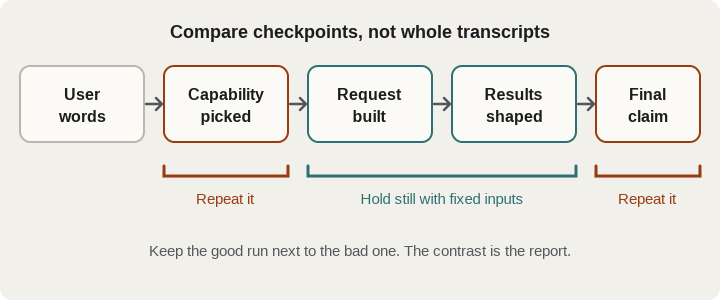
It changes how I save a reproduction, too. For a deterministic failure, one exact input and output may be enough. For variable behavior, I need a small set of observations from the same setup. I keep the successful run beside the failing one, because the contrast is the report. Drop either side and the behavior looks more stable than it was.
One success couldn’t erase the later denial, and one denial couldn’t prove the capability always failed.
The setup has to be recorded with equal care. Conversation state, available capabilities, and earlier turns can all affect what happens next. If those conditions change between repetitions, I’m no longer asking whether the same request varies. I’m testing several requests that only look alike on the last line.
So I reset what I can, hold the meaningful context steady, and compare like with like. Repetition without that discipline produces more output but no clearer observation.
One investigation of red routing cases made this concrete. The failures weren’t all one kind. Some expectations had gone stale. Some sequential cases were limited by the test setup. Others reflected real behavior gaps. The repair put changes at distinct points instead of treating every red result as a reason to alter the product broadly.
A red case is the start of a question. Did the product violate an intended behavior? Did the harness create a state the product would never see? Did the expected answer freeze an older decision? Did a variable component simply choose another valid wording?
For a changing answer, the report needs the input, the controllable setup, the step that differed, and the range of observed outcomes. I don’t have to pretend every word should match. I do have to say when one run claims a capability exists and another claims it doesn’t.
In a deterministic test, the expected result may be one exact structure. In a behavior check, the acceptable result can be a set of properties: pick the relevant capability, keep the requested scope, include the required context, and don’t claim failure when the capability is available. The wording can move while those obligations stay put.
The goal isn’t to make every assistant answer identical. That would confuse repeatability of the setup with sameness of the generated sentence. The goal is to surround the variable part with steady observations, then repeat the part that genuinely varies.
When those lanes get mixed, a flaky fixed check is excused as assistant variation, and a variable behavior check gets forced into exact text and fails over harmless changes. Keeping them apart lets each failure say something narrower.
Comparison needs a stable unit as well. I compare the picked capability with the picked capability, the built request with the built request, and the final claim with the final claim. Comparing whole transcripts makes every wording change look equally important. Comparing checkpoints shows whether the system changed its action, its data, or only its phrasing, and that decides what I look at next.
The list request showed the visible version of this. The conflicting answers mattered even before anyone knew the cause. One success couldn’t erase the later denial, and one denial couldn’t prove the capability always failed. The honest result was: this varies under repetition.
So I’d run the request again, but I wouldn’t stop there. I’d look beneath the sentence for the last steady checkpoint. If the structured request stayed correct and the picked capability changed, the report would say so. If the pick stayed correct and the final response changed its claim, the report would say that instead.
The answer may change. The report should show where.