I Asked for the Same 8 KPIs. The Assistant Invented a Ninth.
One plain request, asked again and again, never came back the same way twice. Then a metric showed up that the product doesn't have.
I asked the assistant to show all eight KPIs for a project, and one of the answers had a line the product doesn’t have. It sat in the table with a value beside it, formatted exactly like the real ones.
So I asked again, and the set changed. Metrics I’d asked for were gone. Others I hadn’t asked for had taken their places. Every version still introduced itself as the complete eight. Paraphrased, one of them read like this:
Show me all 8 KPIs for Project A.
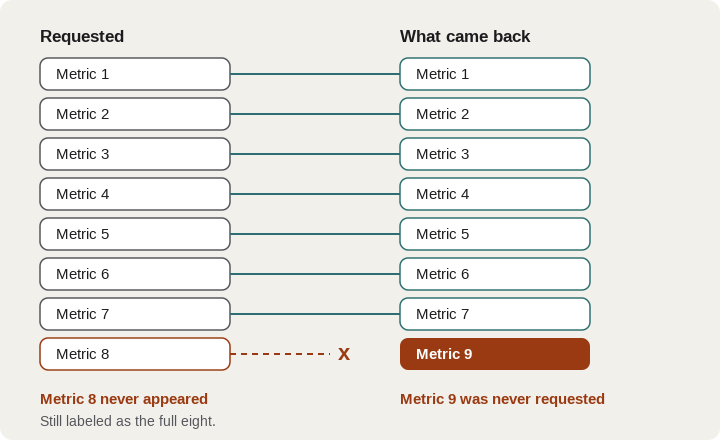
Here are all 8 KPIs for Project A: Metric 1, Metric 2, Metric 3, Metric 4, Metric 5, Metric 6, Metric 7 and Metric 9.
Count them. Eight names, one of which was never on the list. Nothing in the layout hinted at it, and the numbers underneath hadn’t changed between asks, only the report built around them.
I kept pulling on the thread, because a wrong set was only the first kind of wrong. Here’s what else turned up across those answers.
Labels didn’t match values. One answer put a budget-consumption percentage under the name of a different metric, utilization, which measures billable hours against logged hours and has nothing to do with budgets. In another, one metric’s value hung under a second metric’s name, with a sentence describing the wrong one. Both looked fine at a glance. Both were wrong.
The surrounding context drifted. Sometimes the answer opened with a project overview and sometimes it jumped straight to the table. The same project, asked in separate conversations, produced reports whose structure, field names and status words didn’t agree with each other.
Absence got rewritten. A project with no revenue has no margin, because the calculation divides by zero and the honest result is “not calculable yet.” Somewhere on the way to the screen, that nothing became 0%. In other answers a field appeared with only “data not available” and no explanation, and in another, a metric the product can compute was declared unavailable for individual projects.
Health labels were made up. When the lookup that classifies a project’s health failed, the assistant didn’t say so. It wrote its own labels, “Healthy” among them, and put them beside financial figures that didn’t agree with each other. Zero values and missing values also got called healthy, which meant a project with no data looked like a project doing well.
That’s the thing I couldn’t stop noticing. The answer had the shape of a finished report, and that shape did the persuading. Labels, numbers and a confident tone made the questions easy to skip. Was this the promised set? Did each label describe the value under it? Did a missing value stay missing? Would the same request mean the same thing in another conversation?
Those are four different states that people casually lump together, and the assistant lumped them too. Zero means something was measured and came out zero. Missing means the data held no value. Unavailable means the system couldn’t get it this time. Undefined means the math doesn’t make sense for these inputs. Collapse them all into zero and you get a tidy table and a false report.
The answer had the shape of a finished report, and that shape did the persuading.
Counting rows was only my first check. A report can contain exactly the expected number of lines and still be wrong, because one requested metric is missing and an unrelated one has taken its seat. So I started thinking of the check as a table, with one row per expected metric. Each row needs a definition, a source state, the label the answer used, the value it showed, and whatever the answer said about it. The table isn’t something the user sees. It makes substitutions visible. An unrelated metric can’t quietly take a slot, and a missing value can’t borrow the look of a measured zero.
Comparing in both directions catches different things. Start from each requested metric and trace it to a label and a value, and you find omissions. Start from each line in the answer and ask what justifies it, and you find inventions.
I didn’t need every sentence to match between runs. The wording can vary. What can’t move is which metrics are in the set, what each one means, and what the answer is allowed to claim when a value isn’t there. That’s why exact-text matching would have been a poor test. It could reject a harmless rephrasing and still miss that utilization had quietly turned into a budget figure.
Somewhere in there the number eight stopped being the point. It was the first request small enough to see everything going wrong at once. Over the following weeks the work spread well past it. The team was closing gaps against the earlier KPI experience, so the assistant could reach more metrics. Measures that other comparisons depended on had to be defined before anything could be checked. One planned comparison, for instance, had no second side until a missing measure existed. We added checks on values over time, so a trend line couldn’t disagree with the tile above it, and checks on the numbers themselves, since an answer with the right shape and a wildly wrong magnitude would have passed the old tests.
I also added a check that takes each number the assistant shows and compares it with what the product itself calculates. To prove it could see the problem, I deliberately swapped the basis of a calculation underneath a well-formed answer, and the comparison rejected it. A check that has never failed on purpose is just a hope.
A longer list wouldn’t have helped on its own. More metrics with no definitions only create more places for a plausible answer to go wrong. What helped was more definitions, an honest treatment of missing information, and repeatable checks around the parts that shouldn’t move.
I’d started with the smallest request I could think of: show me all eight. It turned out to have eight ways to go wrong and a ninth I hadn’t thought to look for.
The next thing I wanted to know was what happens when every number is right and the sentence wrapped around them still isn’t.